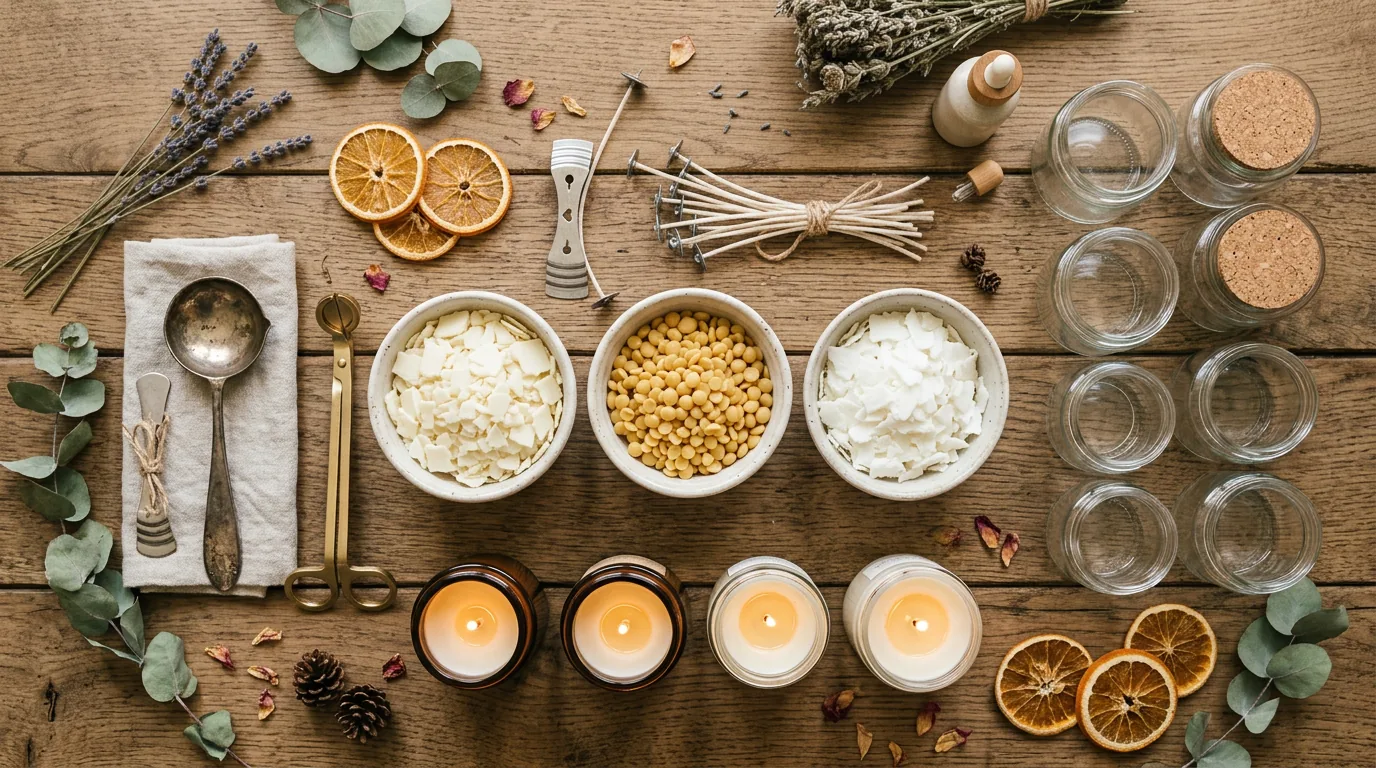
Botanical candles are among the most visually captivating trends in home candle making. Dried lavender sprigs, delicate rose petals, eucalyptus cuttings, or small star anise – any of these can transform a simple candle into something that feels like a genuine artefact, something you want on your bedside shelf, your bathroom counter, or wrapped up as a gift for someone who appreciates beautiful things. And yet this is also the area where many makers run into their first real questions: how do you do it correctly? Are botanical elements actually safe? How do you make a candle that looks beautiful and still burns properly?
The answers depend quite a bit on what kind of result you’re aiming for. In this article, we’ll walk through the essential rules – from choosing the right materials and deciding where to place botanicals in the wax, to the safety principles you should always keep in mind.

Why botanical candles feel so special
There’s something almost ritualistic about them. A candle by itself already sets a mood. But a candle with lavender sprigs, citrus slices, or a closed rose bud carries something more – a sense of nature, of season, of a garden or a forest walk held still in wax. That’s why they’re loved not just as home décor but as gifts. Each one is slightly different, each one is handmade, and you can feel that.
That said, the beauty comes with a little extra care and thought. Botanical elements aren’t just an aesthetic detail in a candle – they are flammable materials, and that requires a responsible approach. The good news is that with the right precautions, botanical candles are perfectly safe and genuinely enjoyable to make.
What works and what doesn’t
Not everything that looks beautiful dried belongs inside a burning candle. The general rule is straightforward: anything that catches fire quickly and unpredictably has no place in a candle. What is dry, compact, and naturally sturdy can work – but placement still matters enormously.
Botanicals that are generally safe to use: dried lavender in sprigs (not loose buds), dried citrus slices (orange, lemon, grapefruit), eucalyptus sprigs and leaves, rosemary, cinnamon sticks, star anise, dried rose buds or lavender buds, and dried bay leaves or myrtle leaves.
Use with caution or avoid entirely: loose small herbs or seeds that ignite easily, fresh or slightly damp botanicals that can rot or spoil the wax, and any botanicals with thin protruding tips or fine filaments that catch flame quickly.
The key factors are dryness and compactness. Botanicals should not have thin sticking-out ends that could easily catch fire. Everything you place in the candle should be flat or nestled beneath or near the wax surface.

Where to place botanicals in the candle
There are essentially three approaches, and each gives a different visual result with different safety considerations.
The first is on the outer surface of the wax after it has set. This popular technique involves pressing or adhering botanical elements to the outside of a finished, cooled candle. It’s visually striking, but keep in mind that these elements are in direct contact with the flame from the very first burn. This method requires that the flame simply never reaches the botanicals – which means enough clearance around the wick and not burning the candle too deeply.
The second approach is inside the wax along the walls of the container. You press the botanical elements against the inner surface of a clear glass container and pour wax over them. The result is beautiful – the candlelight shines through the botanicals from within. The elements are encased in wax, so the safety risk is lower, but you still need to ensure the botanicals don’t protrude above the container and don’t sit too close to the burn zone.
The third is placing botanicals on the surface as a finishing detail. The simplest approach: pour the candle, let it set until the surface is just barely still soft, then gently press the botanicals in. Once fully set, they’re fixed in the top layer. This is relatively safe as long as the elements aren’t too large or placed too close to the wick.
The general principle: the closer to the flame or the wick zone, the higher the risk. Botanicals should never sit directly beside the wick or in the centre of the candle near the burn area.
Safety first
Never leave them burning unattended. This is true for all candles, but doubly so for botanicals. Dried herbs and flowers can catch fire faster than a flame goes out. Keep the candle in your line of sight.
Trim the wick before every burn. A shorter wick (around 5–7 mm) produces a smaller flame that reaches the surrounding botanicals more slowly. This is a good habit for any candle, but for botanicals it’s essential.
Watch the first burn carefully. The burn test matters especially here. The flame should be calm and steady, not flickering toward the sides. If anything outside the wax ignites, extinguish immediately and reconsider the placement.
Don’t overload with botanicals. Less is more. One small sprig or bud can look more elegant and feel safer than a candle that’s packed so full it looks more like a wreath than a functional object.
Working with fragrance in botanical candles
Botanical elements can add a natural tone to the scent, but they won’t contribute much fragrance on their own – drying removes most of their aromatic compounds. So you’ll still want to add fragrance oil, and the same rules apply as always: respect your wax’s recommended fragrance load and test before committing to a batch.
One thing worth thinking about: if you’re using botanicals with a strong natural scent of their own – lavender, rosemary, cinnamon – choose a fragrance oil that complements rather than competes. Combining a synthetic lavender fragrance with real dried lavender sprigs in the wax can result in something surprisingly intense. Start with a slightly lower fragrance percentage than usual and adjust based on testing.
Think seasonally. Citrus slices pair beautifully with fresh, bright spring and summer fragrances. Cinnamon and star anise work with warm, spiced notes. Lavender is wonderfully neutral and plays well with many scents. Eucalyptus and rosemary feel clean and minimal.
Tips for a beautiful result
Use botanicals that are genuinely completely dry. If you have any doubt, leave them out in the air for another day or two, or gently dry them in an oven at low heat (40–60°C) for 20–30 minutes.
Let the candle cool and cure properly before use. With botanicals, this is even more important than usual – the wax needs to set firmly around the elements to hold them in place.
Photograph your candles before lighting them. Botanical candles are most beautiful unburned – once you light them, the botanicals slowly transform or burn away. That’s completely natural and part of the charm, but for photography, the first image is always the best.
If you love the look of botanicals but feel uncertain about the safety, consider making a display candle – one that’s purely decorative and never lit. That opens up a whole different range of possibilities without any of the burn-related concerns.
The takeaway
Botanical candles are a beautiful way to bring natural materials into the craft of candle making. They look stunning, they make beloved gifts, and they give every candle a character that’s entirely its own. They also ask a little more from you than a plain candle without any botanicals.
The key is a responsible approach to material placement, choosing dry and compact elements, and doing a careful burn test before use. Follow those principles, and botanical candles will reward you.
As with everything in candle making, the golden rule holds: test, observe, and don’t rush. Then light the candle and simply enjoy it.