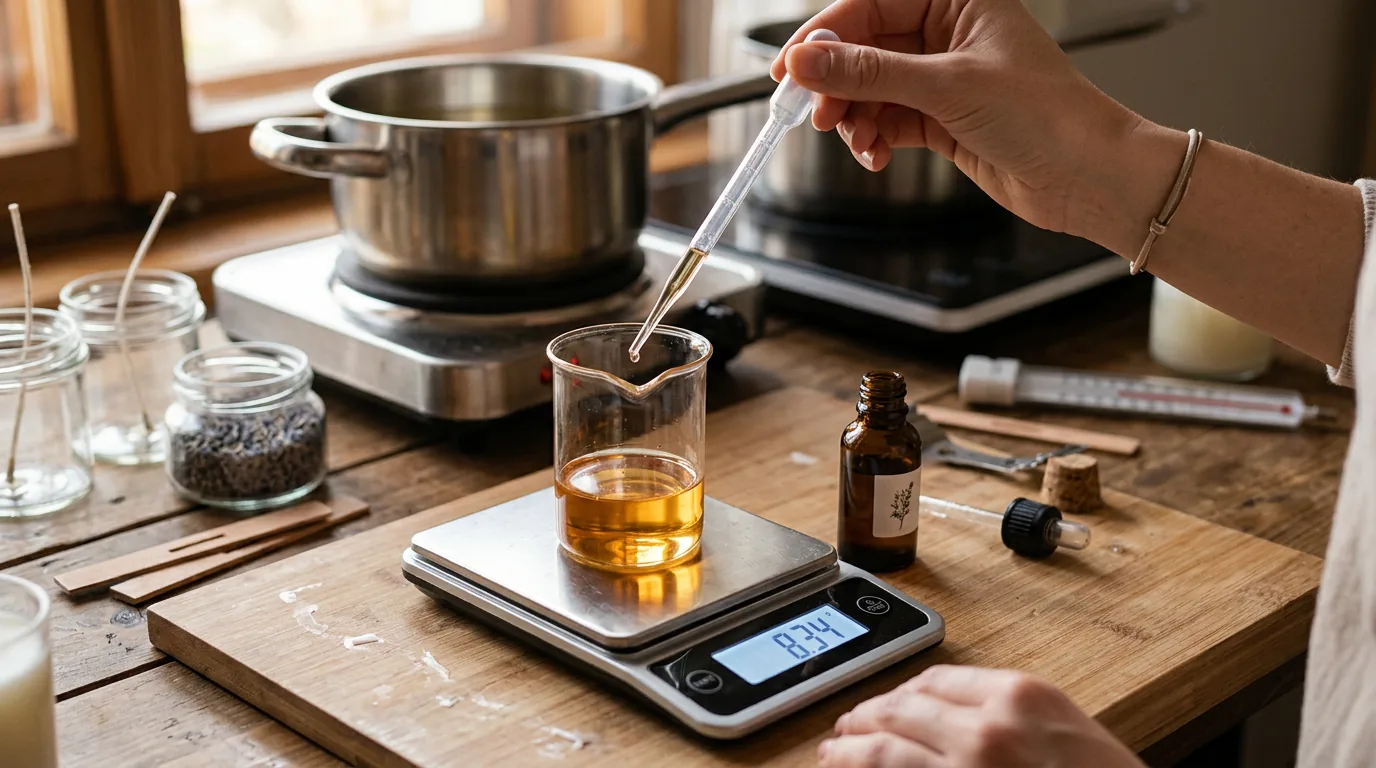
Fragrance is what gives a candle its emotion. It is what creates the atmosphere of an evening, a feeling of cosiness, cleanliness, luxury, or a seasonal mood. It’s no wonder, then, that many beginners are tempted to add as much fragrance as possible for the strongest result. But with candles, more does not automatically mean better. Correct dosage is one of the most important steps in the entire process, and it can determine whether a candle will smell beautifully or cause problems when burning.
A well-calibrated amount of fragrance must work on two levels at once. Firstly, the scent should be pleasantly noticeable both cold and when lit. Secondly, the candle’s stability must be preserved – good burning, proper bonding with the wax, and a nice surface. If there is too much oil, the wax may not absorb it properly. The result can then be a greasy surface, sweating, a weaker flame, or problematic burning. And that is precisely why it’s so important not to rely on guesswork, but on a simple calculation.
What fragrance load means
In the candle world, the term “fragrance load” is commonly used, referring to the percentage of fragrance oil relative to the amount of wax. In other words, it’s about how much fragrance you add to your wax batch. Most common waxes work somewhere in the range of approximately 6% to 10%, but it always depends on the specific material. Some waxes can handle a higher proportion, others need gentler dosing.
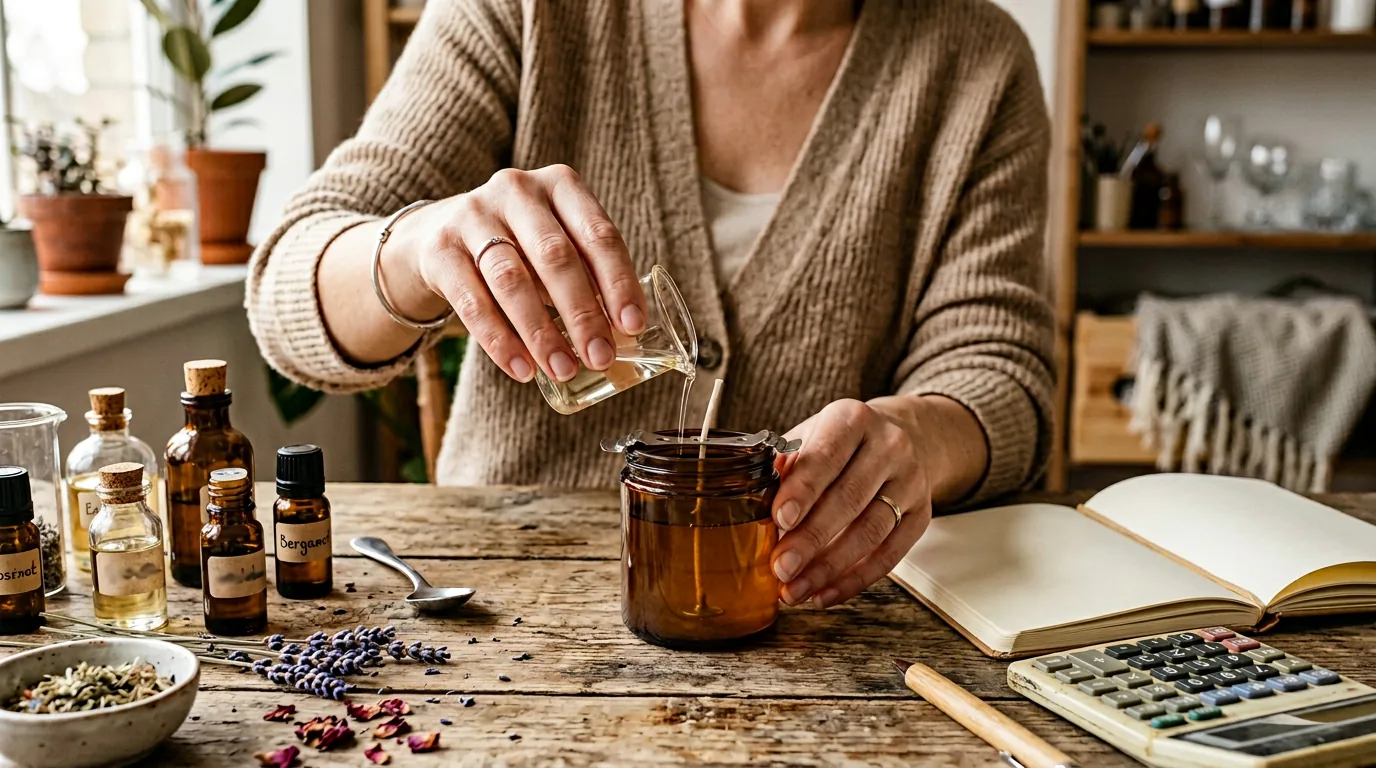
It’s important to know that the recommended maximum is not an invitation to always use it. Many fragrances are beautifully strong even at a lower percentage, and some, conversely, need a bit more room. Everything is also influenced by the type of vessel, the size of the candle, the chosen wick, and the strength of the particular oil itself. So it’s best to treat the percentage as a safe framework, not as a fixed rule for every single recipe.
The basic calculation is simpler than it looks
First, determine how much wax you’ll be using. Then choose the fragrance percentage and simply calculate it from the weight of the wax.
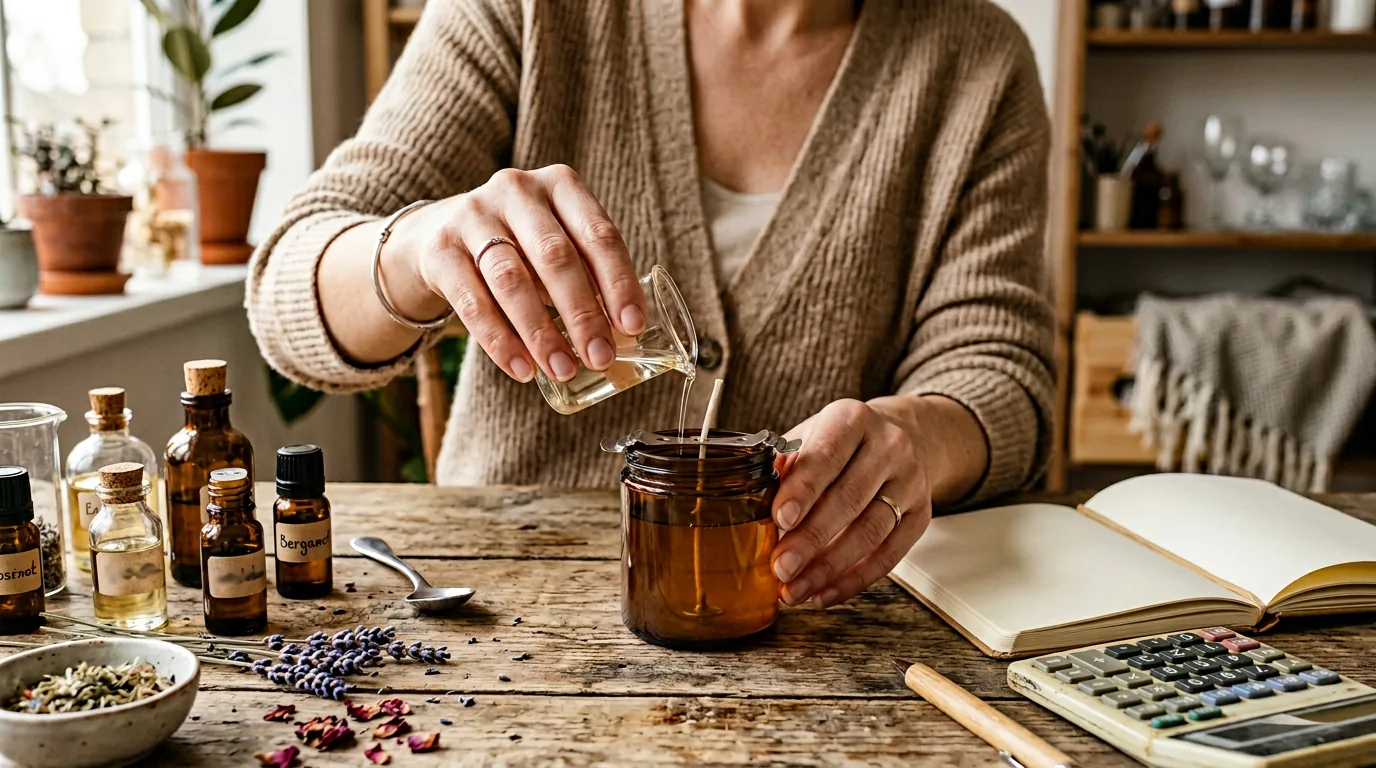
The formula looks like this:
amount of fragrance = weight of wax × (fragrance percentage / 100)
So if you’re working with a batch of 500 g of wax and want to use 8% fragrance, the calculation is:
500 × (8 / 100) = 40 g
This means you’ll add 40 g of fragrance oil to the wax.
If you want a gentler scent at, say, 6%, the calculation will look like this:
500 × (6 / 100) = 30 g
And this is where you can clearly see that even a few percentage points make quite a big difference in practice. That’s why it pays to weigh really precisely and not rely on “just adding a bit extra”.
Why estimating fragrance doesn’t pay off
Many people are tempted at the start to simply pour fragrance “by feel”. But at that point, you lose control of the outcome. If the candle doesn’t smell enough, you won’t know why. If burning problems appear, it won’t be clear whether the issue was the wick, the wax, or the amount of fragrance. Precise weighing gives you confidence that you’re working reproducibly and can gradually improve your results.
This is hugely important from a practical standpoint too. Once you create a fragrance that turns out well, you’ll want to be able to replicate it. And without recording and weighing, that simply isn’t possible. This is where a home experiment becomes a thoughtful hobby with real quality.
When to add fragrance to the wax
Knowing how much isn’t enough – you also need to know when. Fragrance oil isn’t added to wax at random. If the wax is too hot, the more delicate components may begin to dissipate needlessly. If it’s too cool, the fragrance may not bond properly and distribute throughout the mixture. Every wax has a recommended fragrance addition temperature that’s worth respecting.
Generally speaking, the wax should be sufficiently liquid and stable, but not overheated. After adding the fragrance, stir slowly and thoroughly, usually for at least one to two minutes. Stirring is not just a formality. This is the moment when a good bond forms between the wax and the oil. Anyone who rushes this step often sets themselves up for future disappointment.
Why a candle sometimes smells weak, even when there’s enough fragrance
A weak scent doesn’t automatically mean you added too little. There can be several causes. The quality of the oil itself plays a major role, as does the type of wax, proper mixing, cure time, and the chosen wick. Some candles smell very pleasant cold but aren’t as strong when lit. Others, conversely, surprise you only when burning. That’s why it’s important to perceive fragrance on two levels:
- Cold throw – the candle’s scent when unlit.
- Hot throw – the scent when burning.
Both are important and not always equally strong. Sometimes you need to adjust the wick, sometimes change the fragrance, or give the candle a longer cure time. The main thing is not to panic and not to automatically solve everything by pouring in more oil.
What percentage to choose at the start
If you’re just beginning, it’s usually wise to stick to the middle of the recommended range. For many soy waxes, a safe starting point is around 7% to 8%. That tends to be enough for a nicely scented candle while maintaining stability and good burning behaviour. With bold gourmand or spicy fragrances, you often don’t need to go very high. Conversely, some delicate floral or clean tones may come across more subtly.
A good strategy is to test in small increments. For example, make one test batch at 6%, another at 8%, and compare the results. You’ll gain far more valuable experience that way than by blindly sticking to one universal number.
A practical example from home production
Imagine you want to make four smaller candles in glass and you’ve prepared 800 g of wax. You choose 8% fragrance.
The calculation will be:
800 × (8 / 100) = 64 g
So you’ll need 64 g of fragrance oil. If you wanted the same batch with a gentler 7% fragrance, the calculation would be:
800 × (7 / 100) = 56 g
The difference is 8 g, which might seem small, but in how the candle behaves, it can already be noticeable. And that is precisely why precision and records are so important.
The most common fragrance dosage mistakes
At the beginning, the same mistakes tend to recur:
- Using too high a percentage without regard to the manufacturer’s recommendation.
- Estimating fragrance without a scale.
- Adding oil at the wrong temperature.
- Brief or careless stirring.
- Testing too many changes at once.
When, for example, one candle doesn’t turn out right, it’s not wise to immediately change the wax, wick, fragrance, and pouring temperature all at once. It’s far better to adjust one variable and observe the result. That’s the quickest way to learn.
A simple home system that really works
Keeping a simple notebook or spreadsheet is very practical. For each candle, write down:
- Type of wax.
- Fragrance name.
- Fragrance percentage.
- Temperature when fragrance was added.
- Pouring temperature.
- Wick type.
- Notes after setting and after the burn test.
Over time, this will help you build your own small database of proven recipes. And that is immensely valuable, whether you’re crafting purely for pleasure or one day want to make candles for others too.
Key takeaway
The ideal fragrance dosage is not magic but a combination of simple calculation, correct timing, and a willingness to test. The sooner you get into the habit of weighing and recording your fragrance, the faster you’ll move from random attempts to beautiful, repeatable results. Fragrance is the soul of a candle, but only when it’s in the right proportion.