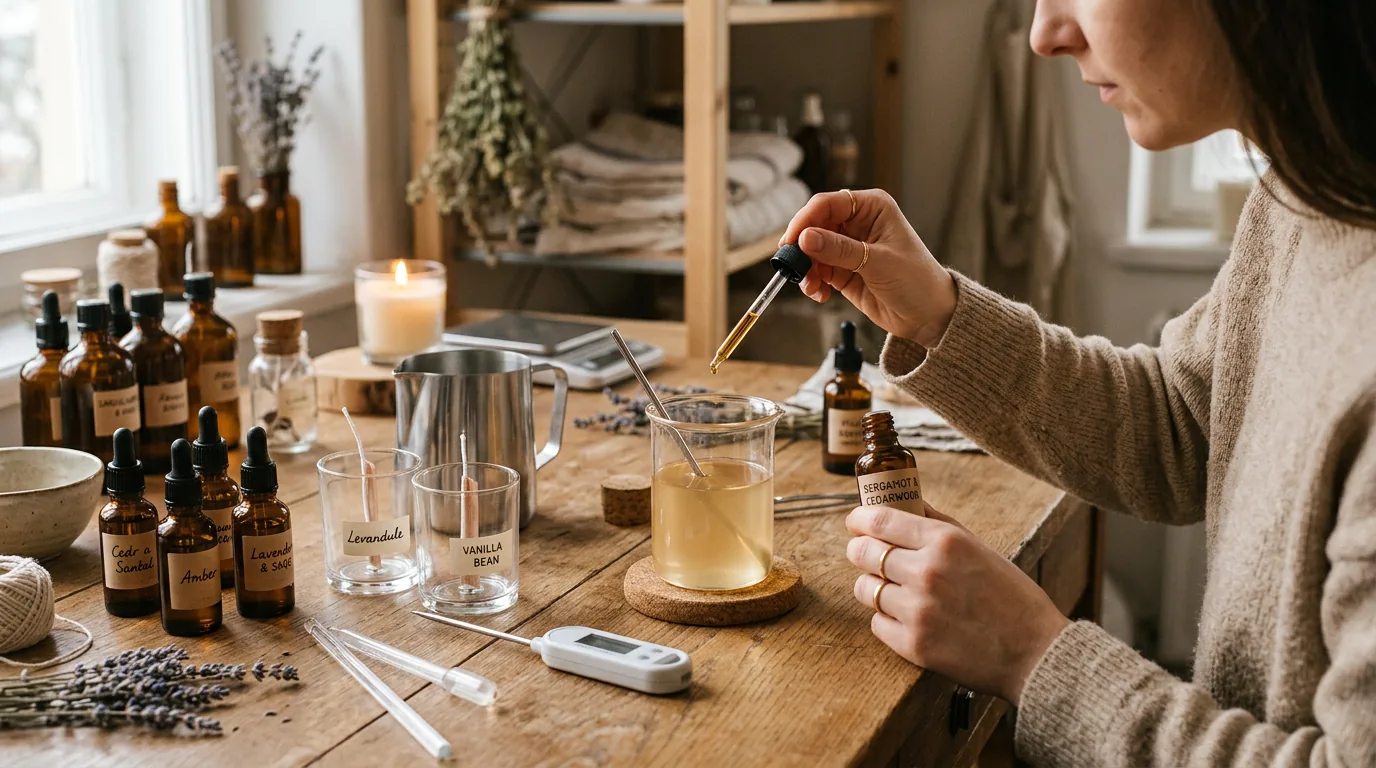
One of the most beautiful phases of candle making arrives when you stop relying solely on ready-made fragrances and start thinking about your own combinations. That’s when a “vanilla candle” can become something much more personal. Perhaps a warm evening composition with a gentle touch of spice. Or a clean, powdery scent reminiscent of freshly made-up bedding. Creating your own fragrance blends gives candles character, emotion, and a personal signature.
Many women are initially a little wary of this stage, feeling that blending fragrances is already something very specialised – almost like a perfumer’s work. In reality, there’s no need to start with anything complicated. A good nose, a willingness to experiment, and a few simple rules are all you need. And that’s the beauty of it. Blending fragrances isn’t just a technique but also a very enjoyable creative activity that beautifully connects intuition with gentle order.
Why create your own compositions
Ready-made fragrances have great advantages. They’re practical, proven, and ideal for getting started. But the moment you blend your own combination, your candle gains an entirely different level of originality. It stops being merely a nice product and starts carrying your mood, taste, and style.
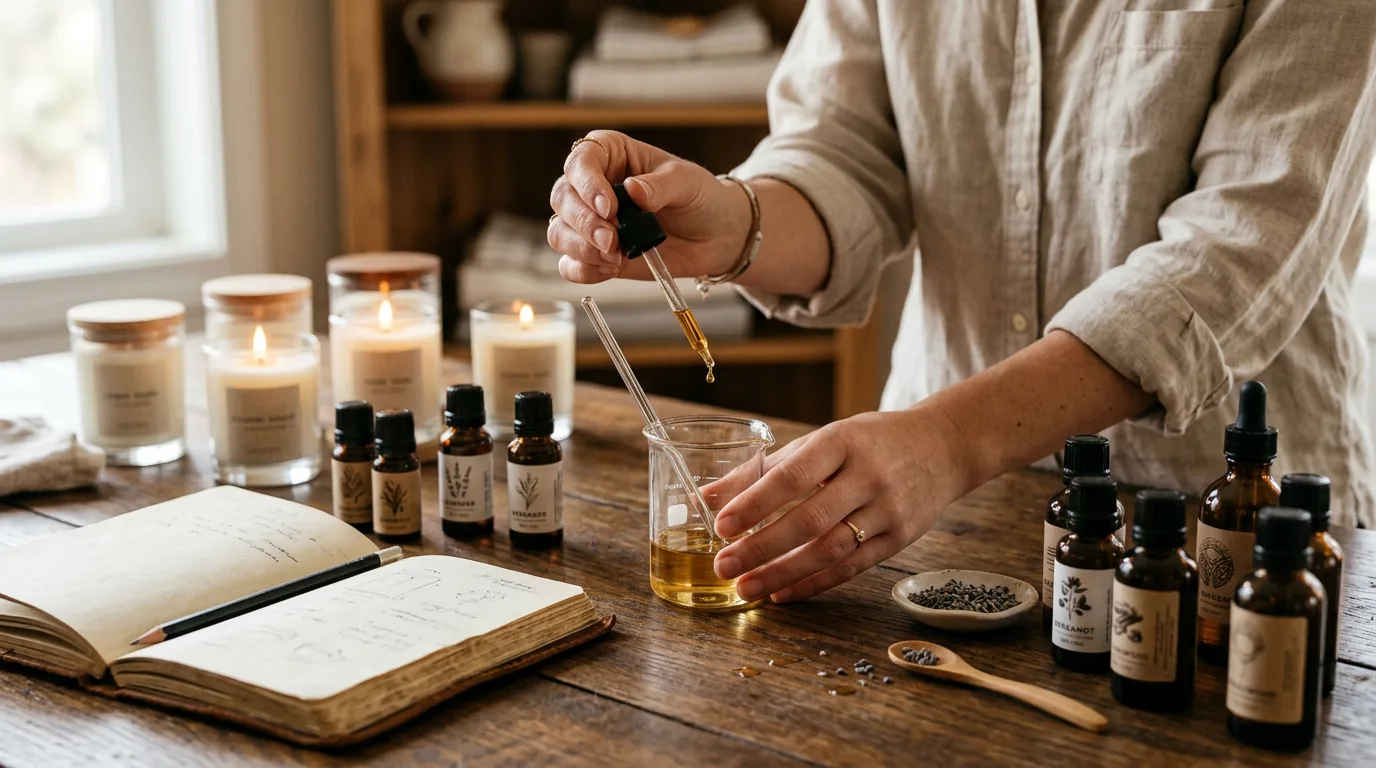
This matters even if you don’t think of candle making as a business. Your own fragrance combinations help you create an atmosphere at home that you can’t buy anywhere. And if you ever wanted to offer candles to others, an original scent can be one of the most recognisable features of your work.
Think in layers
When blending fragrances, it helps to imagine the scent as a whole made up of several layers. You don’t need to go deep into perfume science, but the basic logic is very useful.

A fragrance often contains:
- Lighter, fresher tones that make the first impression.
- Middle tones that form the main character.
- Deeper, warmer tones that anchor the composition and give it atmosphere.
In practice, this might look something like:
- Citrus or gentle mint as a fresh opening.
- A floral or fruity tone as the heart.
- Vanilla, sandalwood, cedar, or amber as the base.
This way of thinking makes it easier to understand why some blends feel flat while others come across as rich and harmonious.
Start simply
One of the best tips for the beginning is: don’t mix too many fragrances at once. Two or three components are more than enough. Once you put in five or six, you very quickly lose track of what actually created the overall impression.
Very nice combinations include, for example:
- Lavender and vanilla.
- Orange and cinnamon.
- Cotton and sandalwood.
- Jasmine and white musk.
- Apple and gentle spice.
- Coconut and tonka.
Such pairs or trios tend to be coherent, elegant, and easy to fine-tune. Plus, it’s easy to notice which component drives the blend and which merely supports it.
The ratio is just as important as the choice itself
It’s not enough to decide which two fragrances to combine. Their ratio plays a major role too. One fragrance may be the lead while the other is just a gentle accompaniment. This is where the difference emerges between a blend that feels considered and one where the individual notes compete.
A practical starting point might be, for example:
- 70% main fragrance and 30% supporting.
- 60% main fragrance, 30% second component, and 10% deeper base.
- 50% and 50% if testing two very similar fragrances.
Recording ratios here is absolutely key. When a blend turns out well, you’ll want to replicate it. And without notes, that would be an unnecessary lottery.
Test “dry” first
Before adding the blend to wax, it’s worth trying it first in a small amount outside of the actual production. Simply create a miniature blend in a test bottle or on paper. This helps you capture the first impression and decide whether the combination has potential.
It’s important to remember one thing, though: a fragrance that smells lovely in the bottle may behave slightly differently in a candle. Heat changes its expression. Some components strengthen, others recede. So the dry test is just a first step, not a final verdict.
Cold throw and hot throw are not the same
When blending fragrances for candles, it’s worth paying attention to the difference between how the candle smells cold and how it smells when lit. Some compositions are gorgeous when you lean in before use, but weaker once lit. Others barely stand out cold and only fully open up during burning.
That’s precisely why it always pays to test your own blends in a small test candle. It’s not enough that the blend “smells nice in a beaker.” You need to find out how it will perform in a real candle, with your specific wax and wick.
How to find your own signature
Your own scent signature doesn’t come from sitting down at a table and creating a perfect branded composition on the first try. It develops gradually. By noticing which fragrances draw you back again and again. Perhaps you’ll find you love:
- Clean and powdery scents.
- Floral and gently feminine tones.
- Warm gourmand combinations.
- Woody and elegant fragrances.
- Fresh herbal blends.
Once you catch that personal direction, creating becomes much easier. You stop trying everything and start building your own scent world. And that comes across as very professional, even if you’re only crafting at home for pleasure.
The most common fragrance-blending mistakes
Beginners often make several similar mistakes:
- Combining too many components at once.
- Not recording ratios.
- Changing fragrance, wax, and wick simultaneously.
- Judging a blend only by the cold scent.
- Dismissing a combination too quickly without a burn test.
In reality, even a blend that doesn’t seem particularly striking on first sniff can surprise with beautiful subtlety and depth once lit. And conversely, a strong fragrance in the bottle can be too heavy in a burning candle.
A practical approach to testing
It’s very useful to set up a small home system. Take one proven fragrance and try adding two or three different supporting components in small ratios. Label each blend, write it down, and create a small test sample. For example:
- Blend A: lavender 70%, vanilla 30%.
- Blend B: lavender 60%, vanilla 20%, sandalwood 20%.
- Blend C: lavender 50%, cotton 50%.
A simple system like this will show you very quickly which direction suits you best. And more importantly, it will teach you to truly perceive fragrances, not just choose them by the name on the bottle.
Fragrance as emotion and story
One of the beautiful things about homemade candles is that fragrances are not just a technical ingredient. They are moods, memories, and feelings. One evokes cleanliness and calm, another a warm kitchen in autumn, another an evening wrapped in a blanket. When you start blending fragrances with this approach, your work will feel much more alive and appealing.
It’s not just about the candle “smelling nice.” It’s about it evoking something. And that is where a maker’s true signature is born.