
When you start exploring candle making, it’s easy to get the impression you need a professional workshop, shelves full of tools, and a shopping list running into hundreds of pounds. A few minutes online and you feel that without special pouring jugs, moulds, organisers, heat guns, and dozens of accessories, there’s no point in even starting. In reality, it’s much simpler. For your first beautiful candles, a few well-chosen basics are all you need.
The most important thing is not the quantity of equipment but its practicality and reliability. One accurate scale, one good thermometer, and one vessel you find comfortable to work with make far more sense than ten unnecessary items. When you choose your basic tools wisely, you save money, frustration, and space in your kitchen or craft corner.
Why it pays to start simply
One of the beautiful things about home candle making is that it can be very accessible. There’s no need to build a small factory at the start. Many beginners find that when they buy too much equipment at once, it paradoxically overwhelms them. They don’t know what to use first, what’s truly important, and what is just a nice extra that might come in handy “some day.”
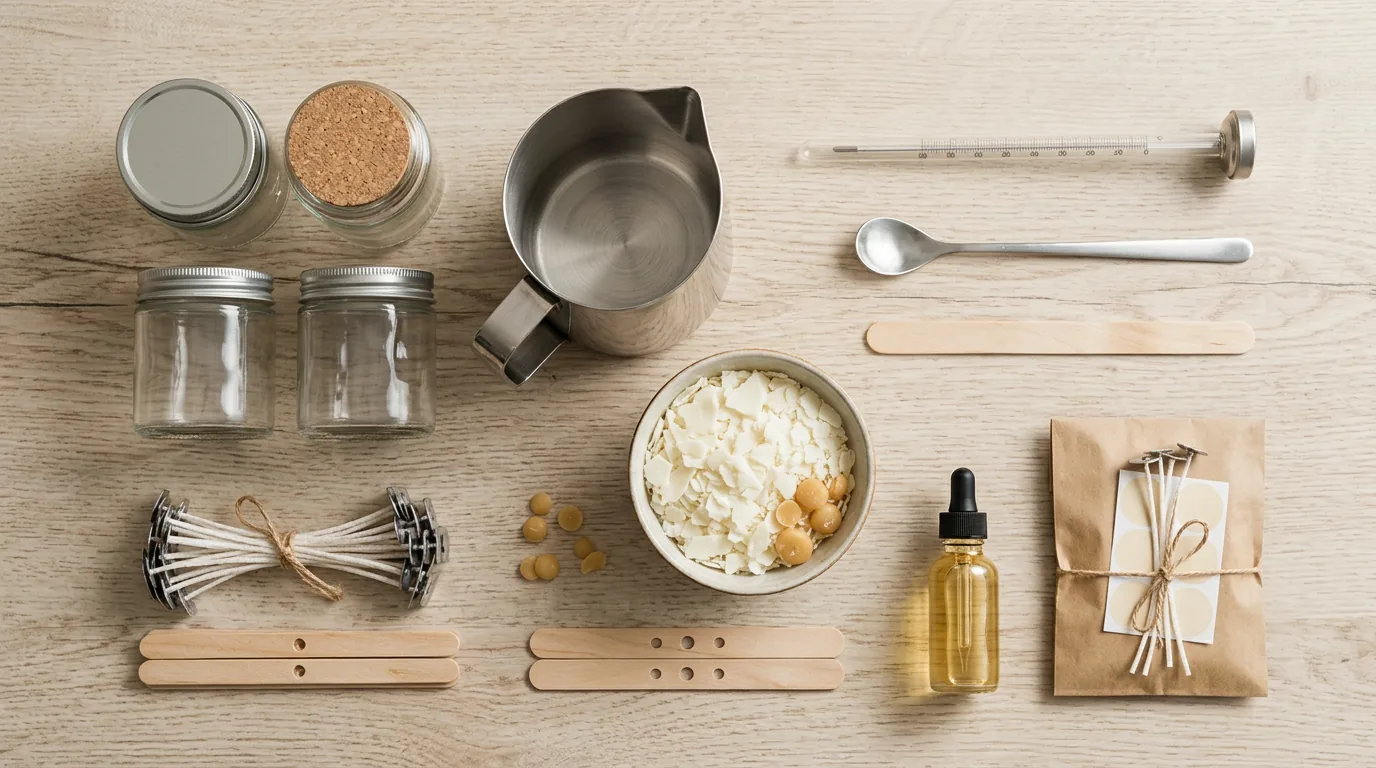
A simpler start has one great advantage: you learn better. When you work with a limited number of tools and materials, it’s easier to understand what exactly affects the result. And for a beginner, that’s far more valuable than a drawer full of accessories.
Digital scales: a small helper with enormous significance
If there is one thing you shouldn’t skimp on when making candles, it’s digital scales. Precise weighing of wax and fragrance is an absolute foundation. Without it, you won’t be able to create repeatable results and later won’t be able to calculate costs sensibly either.

Many people are tempted at the start to estimate volume using cups or measuring jugs, but that doesn’t work well with candles. Wax, fragrance, and other components need to be measured by weight. Scales will help you not only during production but also when comparing individual recipes. It’s thanks to them that you’ll recognise what went well and what you’d like to adjust next time.
Thermometer: precision that makes a difference
Right alongside scales sits the thermometer. It may not seem as attractive as pretty vessels or fragrances, but from a practical standpoint, it’s immensely important. It helps you monitor the melting temperature, the right moment to add fragrance, and the best time to pour.
A surprising number of problems in candle making are caused by working “by feel.” The wax was probably hot enough. I can probably pour now. But small differences in temperature often show up in the candle’s appearance and performance. That’s why the thermometer is one of those unassuming tools that very quickly save beginners a lot of disappointment.
Wax melting vessel
For melting wax, you’ll need a vessel that’s easy to handle and also easy to pour from. It can be a special melting jug or a simpler metal container suitable for a double boiler. The important thing is that it’s heat-resistant, stable, and easy to clean.
For an absolute beginner, there’s no need to buy professional equipment, but it’s worth thinking about comfort. If wax spills all over the worktop when you pour, or the vessel is awkward to handle, it will needlessly put you off. A good pouring vessel is perhaps an ordinary thing, but you’ll quickly grow fond of it.
Double-boiler pot
Wax should be melted safely, ideally in a double boiler. That means you also need an ordinary pot in which to heat the water. It doesn’t need to be new or special, but it’s a good idea to set aside one specific pot for crafting so your tools don’t mix with everyday cooking.
A double boiler is one of the safest and most comfortable methods for home production. The wax heats gradually, is easier to control, and the risk of overheating is reduced.
Candle vessels
No candle can be made without the right vessels, of course. For starters, it’s sensible to choose one or two proven types of jars and stick with them for a while. If you keep switching sizes, shapes, and diameters, testing wicks and wax behaviour becomes much harder.
An ideal beginner vessel should be:
- Heat-resistant.
- Stable.
- Simple in shape.
- Readily available in the future if you want to use it repeatedly.
Repeatability is key. Once you find a jar that works and that you like, you’ve won. You can build further tests and the look of a whole candle range on it.
Wicks and accessories for securing them
Another essential part of the kit is, of course, wicks. It’s also worth buying adhesive dots or glue for fixing, and simple holders for centring. These small items cost little but make work significantly easier.
Anyone who has ever tried to keep a wick centred without tools knows how easily it can shift during pouring. And yet its position plays a major role in how the candle will burn later.
Spatula or spoon for stirring
A silicone spatula, metal spoon, or other sturdy tool that cleans easily works well for stirring wax and fragrance. What matters is that it’s comfortable to use and allows you to mix the blend properly. Silicone tends to be very practical because wax doesn’t stick to it as much and maintenance is simple.
Often it’s the simple tools that determine how pleasant the whole production process is. When everything is hard to clean, sticks, and slips, the energy from creating disappears fast.
Workspace mat and surface protection
Even though it sounds like a detail, a workspace mat or surface protector can really enhance the whole process. Wax occasionally drips, fragrance can leave marks, and a hot vessel needs a safe spot. There’s no need to buy anything special, but it’s pleasant to have a clearly designated area where you can work without stress.
Home candle making is much more relaxed once you don’t have to check after every step whether you’ve dripped something on the kitchen counter or dining table.
What’s useful but not essential right away
Besides basic equipment, there are a number of things that can be very useful but don’t need to be bought immediately:
- A heat gun for surface touch-ups.
- Special pouring jugs of various sizes.
- Moulds for decorative candles.
- Labelling tools.
- Organisers for fragrances and wicks.
- Larger stocks of multiple wax types.
These make sense once you know that candle making has truly hooked you and you want to expand. For starting out, the basics that let you learn without unnecessary investment are more than enough.
The most common equipment-buying mistake
One of the most frequent mistakes is buying everything at once based on photos or first-flush excitement. You can easily end up with tools you don’t need at all, while missing the things that really matter. A much better strategy is to begin with one type of candle – for example, a soy candle in glass – and assemble a minimalist kit accordingly.
Once you gain confidence, you’ll very quickly recognise what would genuinely make your work easier. And that’s when expanding your equipment makes sense.
A basic kit that really is enough
If someone asked me for the very simplest starter kit, it would look something like this:
- Digital scales.
- Thermometer.
- Wax melting vessel.
- Double-boiler pot.
- One type of candle jar.
- Soy wax for containers.
- Suitable wicks.
- Adhesive dots and wick holders.
- One or two proven fragrances.
- Silicone spatula.
- Workspace mat.
With a kit like this, you can already make very attractive candles, learn the whole process, and discover what you enjoy most about this hobby.
When equipment becomes a joy, not a burden
The beauty of well-chosen equipment is that it gives you a sense of calm. You don’t have to improvise anything, everything has its place, and production is more pleasant as a result. That’s especially important in a home setting, where we want to create with joy, not stress.
And perhaps that’s the best advice for the start: don’t buy yourself a workshop – buy yourself a comfortable beginning. Equipment should serve you, not the other way round.