Candle making is a beautiful, calming, and deeply rewarding hobby. You create something fragrant, cosy, and personal that can transform the atmosphere of a home in seconds. That’s precisely where the magic of home crafting lies. On the other hand, it’s worth being upfront about the fact that even though it seems gentle and unassuming, it still involves working with hot wax, glass, heat, and fragrance oils. Safety shouldn’t be just an “afterthought” but a natural part of the whole process.
Many beginners imagine that at home in the kitchen nothing can really go wrong, since it’s hardly a workshop or an industrial operation. But it’s exactly the domestic setting that can lull you into less caution. Stepping away from heating wax, placing a hot vessel on the wrong surface, or working in a rush may seem trivial, but these are precisely the moments when unpleasant accidents happen. The good news is that most of them can be prevented very easily. All it takes is learning a few basic rules and making them part of your creative routine.
Why safety is so important
What’s deceptive about candle making is that it feels so delicate. The wax smells lovely, the jars look decorative, and the whole process is associated with calm and aesthetics. But melted wax is at a high temperature and can cause burns if handled carelessly. Likewise, a glass vessel not designed for use with heat can crack. And fragrance oils, if not suitable for candles, may react differently when heated.
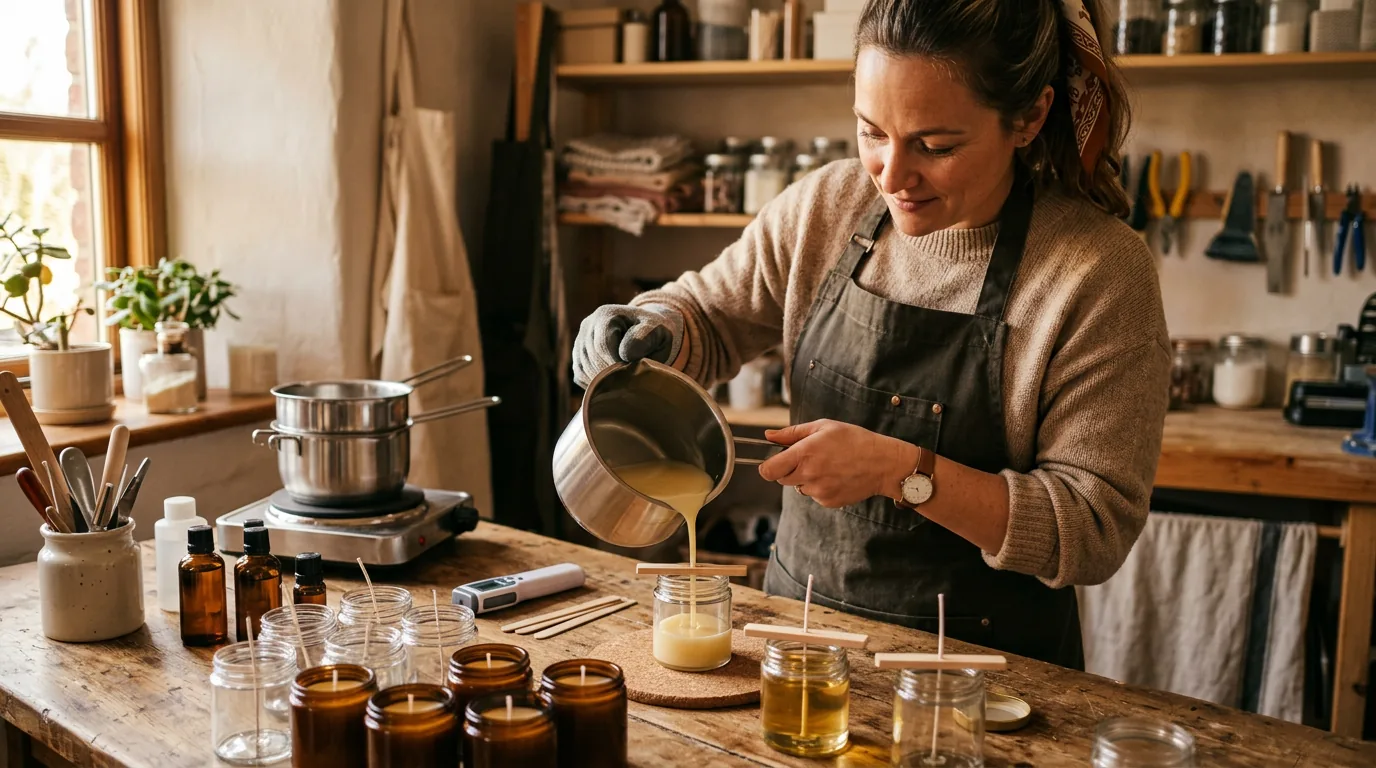
So safety is not just about “being careful.” It’s mainly about prevention. About preparing your space beforehand, using the right tools, and leaving nothing to chance. When you learn this from the start, your production will be much calmer and more confident.
Workspace: the foundation of everything
Before you start melting wax, look around. Do you have enough room? Is the work surface stable? Are there children, pets, or things you could knock over within reach? A well-prepared workspace makes a big difference.
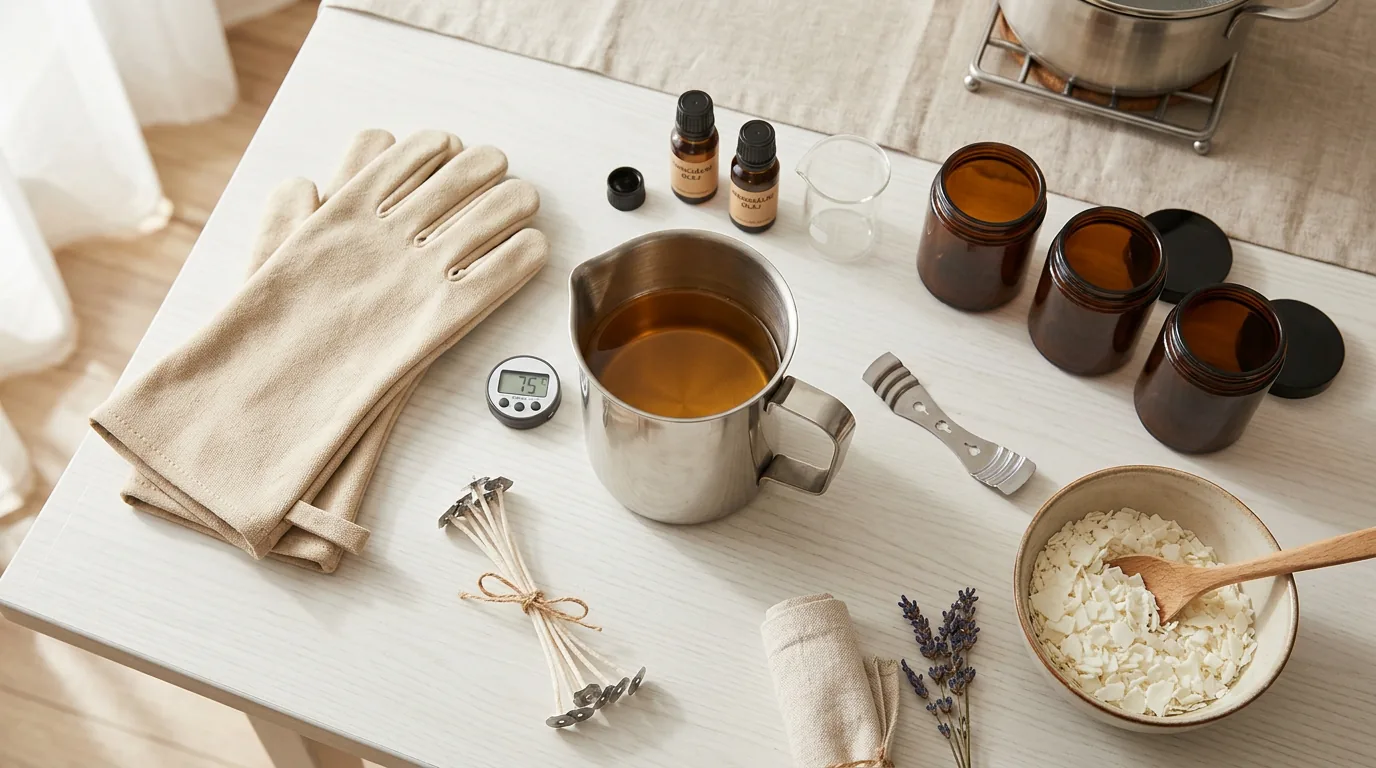
Ideally, have:
- A flat, stable work surface.
- Enough space around the wax vessel.
- A protective mat or old cloth beneath the work zone.
- All tools prepared in advance.
- Clear access to the hob and the area where you’ll set candles down.
When there’s chaos while you work, unnecessary stress arises. And stress leads to rushing. And rushing, when making candles, is one of the biggest enemies of safety.
Never melt wax unattended
One of the most important rules is very simple: never leave heating wax unattended. Not even “just for a minute.” Even when you’re melting a small amount and feel it’ll be fine, it’s precisely this false confidence that tends to be the problem.
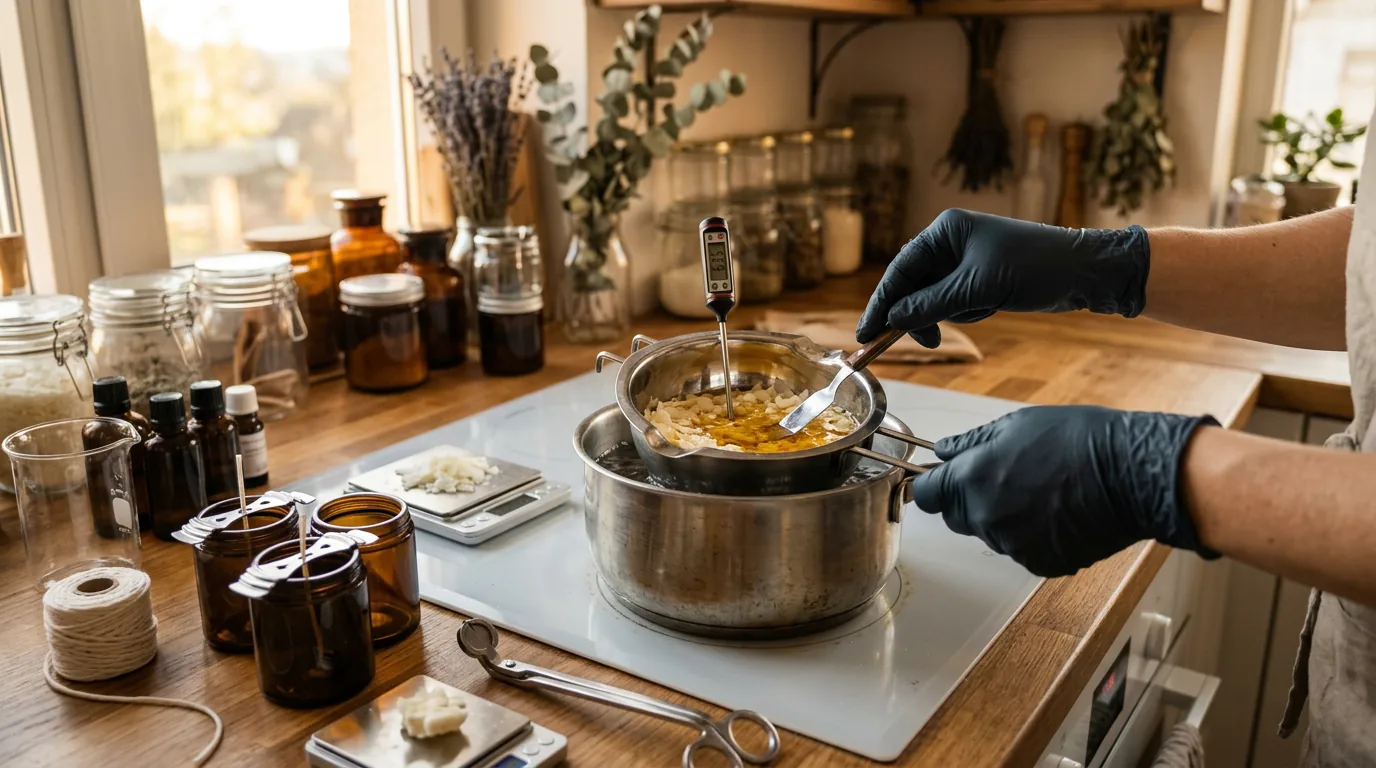
For home production, the safest approach is to use a double boiler. This way, the wax heats gradually and there’s far less risk of direct overheating. Direct contact with a high heat source without control is not suitable, especially for beginners. A double boiler gives the process a calmer pace and allows you to monitor the wax throughout.
Always keep a thermometer beside the wax too. Overheated wax is not just a quality issue for the finished candle but also a safety one. When you learn to monitor temperature automatically, you’ll feel much more confident with every subsequent step.
Clothing and protection when working
It may sound obvious, but clothing matters when making candles too. Loose sleeves that get in the way, or delicate clothing you don’t want anything dripped on, aren’t exactly ideal. Much more comfortable is a simple apron, rolled-up sleeves, and clothes you can move freely in.
It’s practical to have to hand:
- An apron.
- Paper towels or a cloth.
- Surface protection.
- A mat for hot vessels.
It’s not about creating a laboratory environment, but about making sure nothing interrupts or slows you down during work. When wax drips, you’ll know exactly what to wipe it with and where to safely put the vessel down.
The right vessels and tools are not a detail
One common mistake in home production is using random vessels that may look nice but aren’t designed for heat. The same goes for jars for the finished candles. Not every decorative pot or jar is suitable for a candle just because you like its shape.
Use:
- Heat-resistant melting vessels.
- Jars designed for candles or verified thick-walled vessels.
- Wicks and accessories designed specifically for candle making.
- Fragrance oils suitable for candles, not ordinary interior or cosmetic oils without verified intended use.
Using the right materials is a large part of safety. The less improvisation, the less risk.
Caution when adding fragrance
Fragrance oils are a wonderful part of the whole process, but they need to be handled sensibly too. They’re added to hot wax, so it’s important to respect recommended temperatures and work carefully. If the wax is too hot, it can affect not only the resulting scent but also the comfort of working.
Add the oil slowly, stir the mixture calmly, and keep the vessel firmly placed. Spilt wax with fragrance is much harder to clean than plain wax and also needlessly adds tension to the work. A calm pace is the best safety rule here too.
Hot wax and skin
Melted wax can cause an unpleasant burn. That’s why it doesn’t pay to pour in a rush or hold the vessel awkwardly. If you do have a minor contact with wax, don’t react with panic, but bear in mind that it’s a hot substance that can remain stuck to the skin for a moment.
Far more important than dealing with consequences, however, is preventing such situations. Hold the vessel firmly, don’t overfill it, and don’t carry it over obstacles. If you can, design your workflow to be as simple and smooth as possible.
Children and pets
In an ordinary household, this is an extremely important topic. Even if you only make candles occasionally and in small batches, bear in mind that a curious child or a dog underfoot can turn calm crafting into a very unpleasant situation. Ideally, create when you truly have space and peace to work.
Leave candles to cool:
- Out of children’s reach.
- Out of pets’ reach.
- In a spot where they can’t be knocked over.
- Away from draughts and everyday household traffic.
It’s not just the melting and pouring moment that matters, but also the time after production. A finished candle may look solid on the outside, but inside it may not yet be fully stable.
What to keep close for calmer work
You don’t need to be overly cautious to the point of stressing yourself out. But having a few practical things within reach helps:
- Thermometer.
- Mat for hot vessels.
- Cloths for small drips.
- A prepared spot for candles to cool.
- An overview of what you’ll be doing step by step.
When you know what you’re doing and where to put each item, work is calmer. And the calmer the work, the safer it generally is too.
Safety continues after production
Many people see safety as relevant only during melting, but it carries on afterwards. Once you’ve made the candle, it’s good to think about safe usage as well. If you gift candles or eventually sell them, they should include basic instructions:
- Trim the wick before lighting.
- Never leave a burning candle unattended.
- Don’t place it on a flammable surface.
- Keep it out of children’s and pets’ reach.
- Don’t burn it for too long at a stretch.
All of this seems very obvious, but clear instructions are exactly what turn home crafting into a responsible and professional approach.
Safety as part of elegance
The beauty of candle making is that it can be practical and aesthetic at the same time. And the same applies to safety. It needn’t feel strict or technical. It can be part of the overall culture of creating. A prepared space, a calm pace, a clean work surface, and the right tools actually create the same atmosphere as the production itself: order, comfort, and confidence.
And that’s precisely the point. Safety is not something that takes the magic out of candle making. On the contrary. It gives you the freedom to truly enjoy it.